Project 09 Simulation · Physics
Drone Physics Lab
A drone physics sandbox: change mass, thrust and wind, fail a motor mid-flight, then fly it with your phone.
Overview
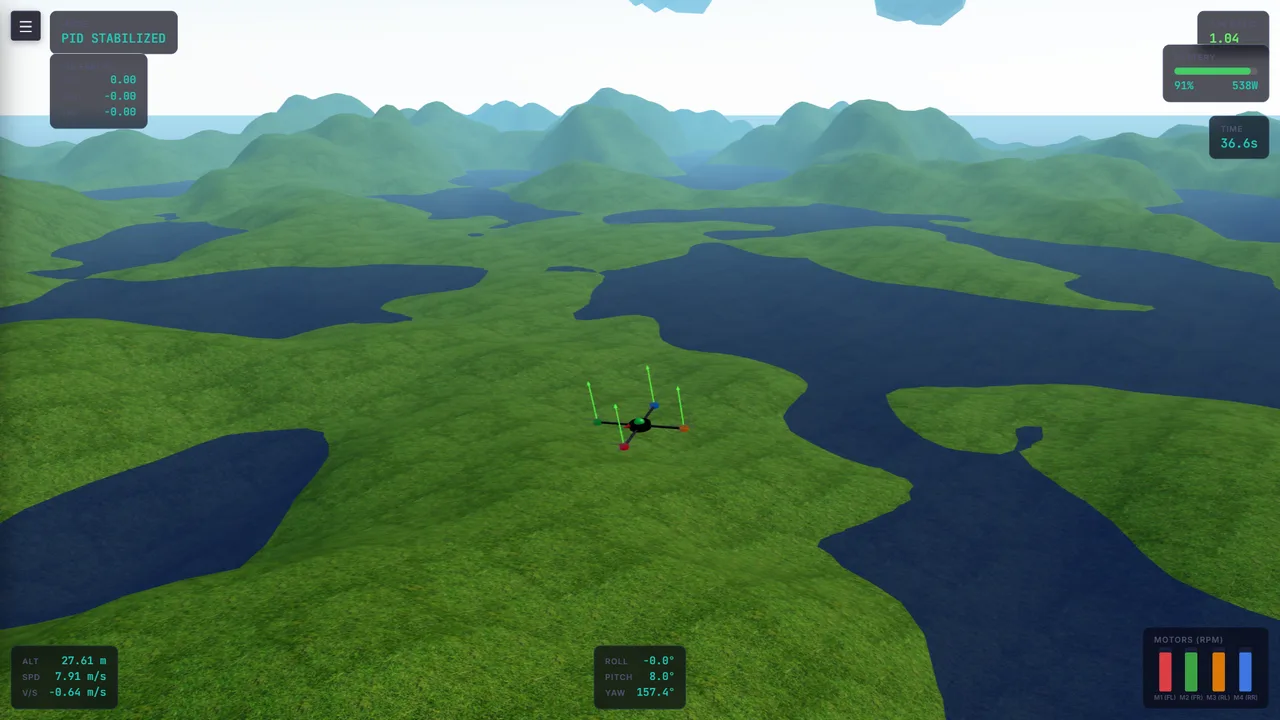
Drone Physics Lab is a drone physics testing simulator. It lets you manipulate real-life physics, components and the drone’s balance, and simulate critical situations like motor failures, so pilots can train effectively.
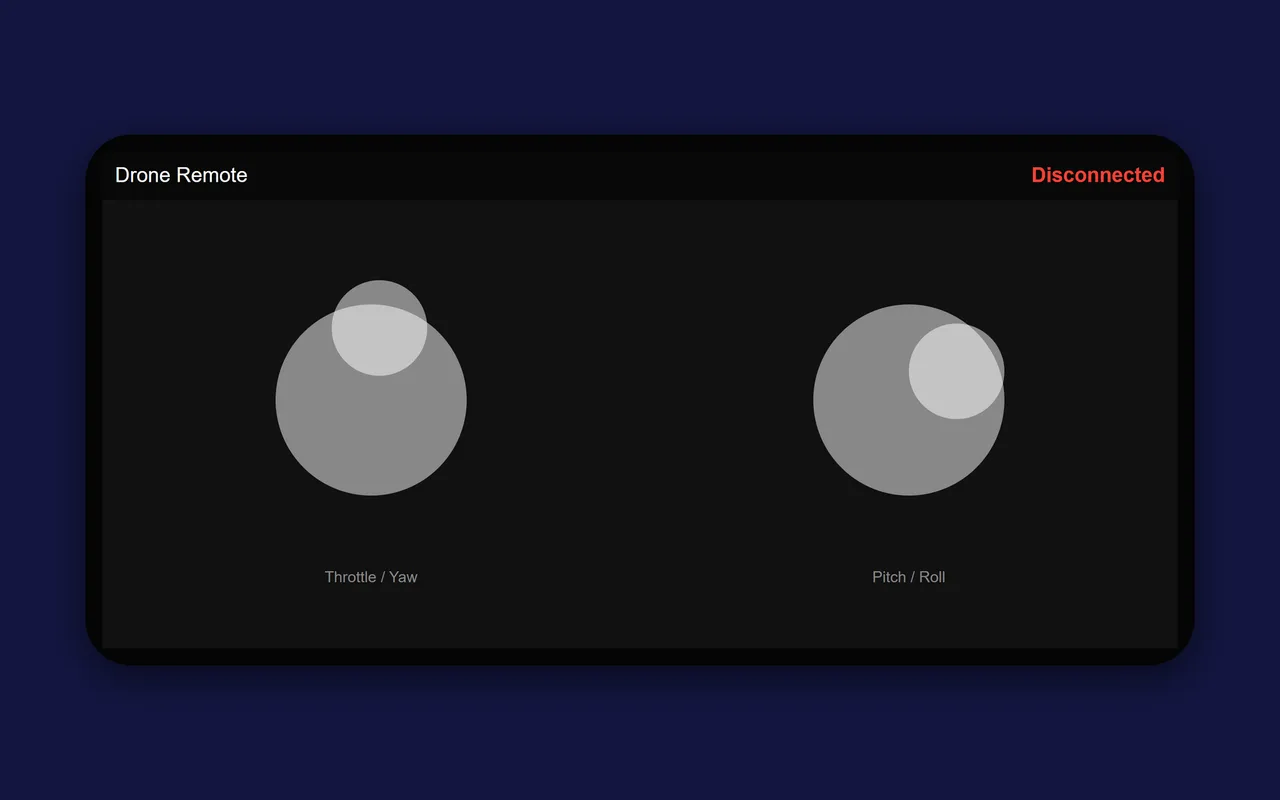
When it runs locally, your phone becomes the remote: connect through its browser and fly with dual virtual joysticks.
The problem
Motor failures and bad balance are exactly the situations pilots need practice for, and exactly the ones you can’t safely rehearse with a real drone.
How it works
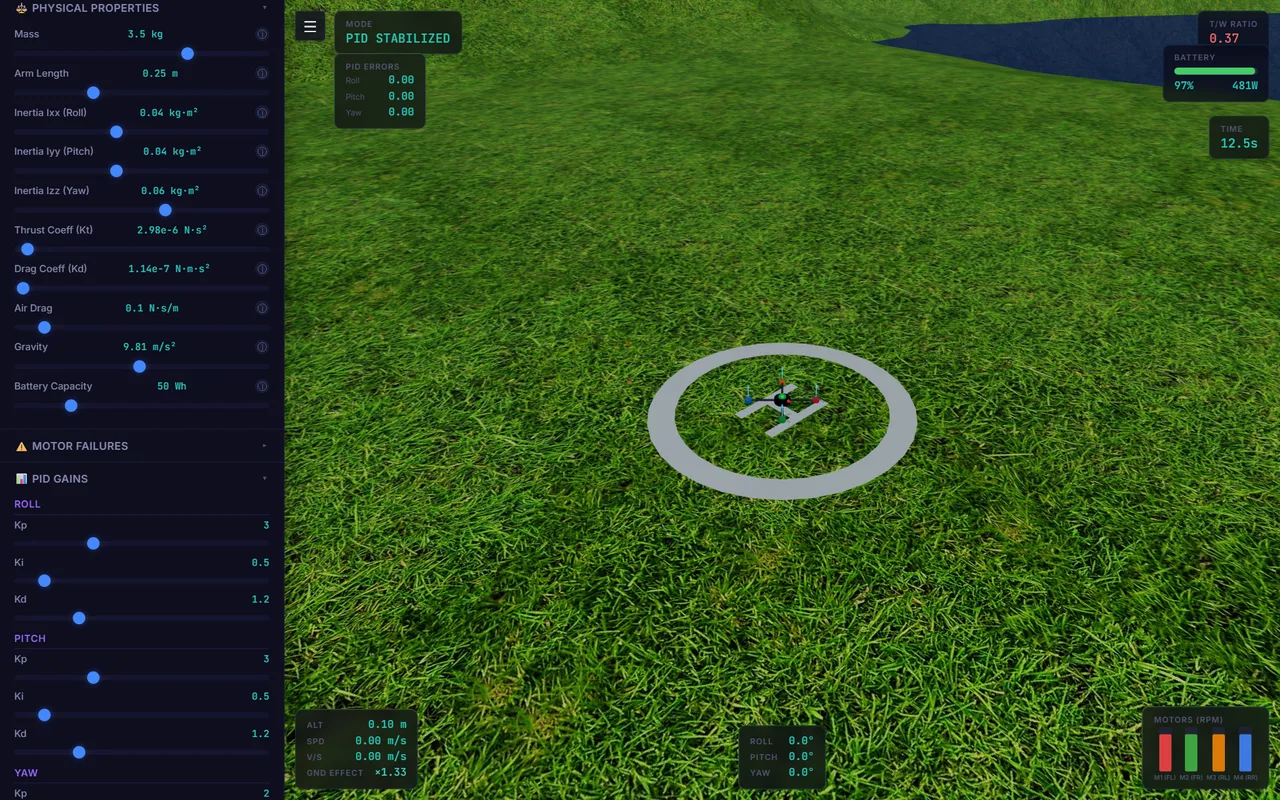
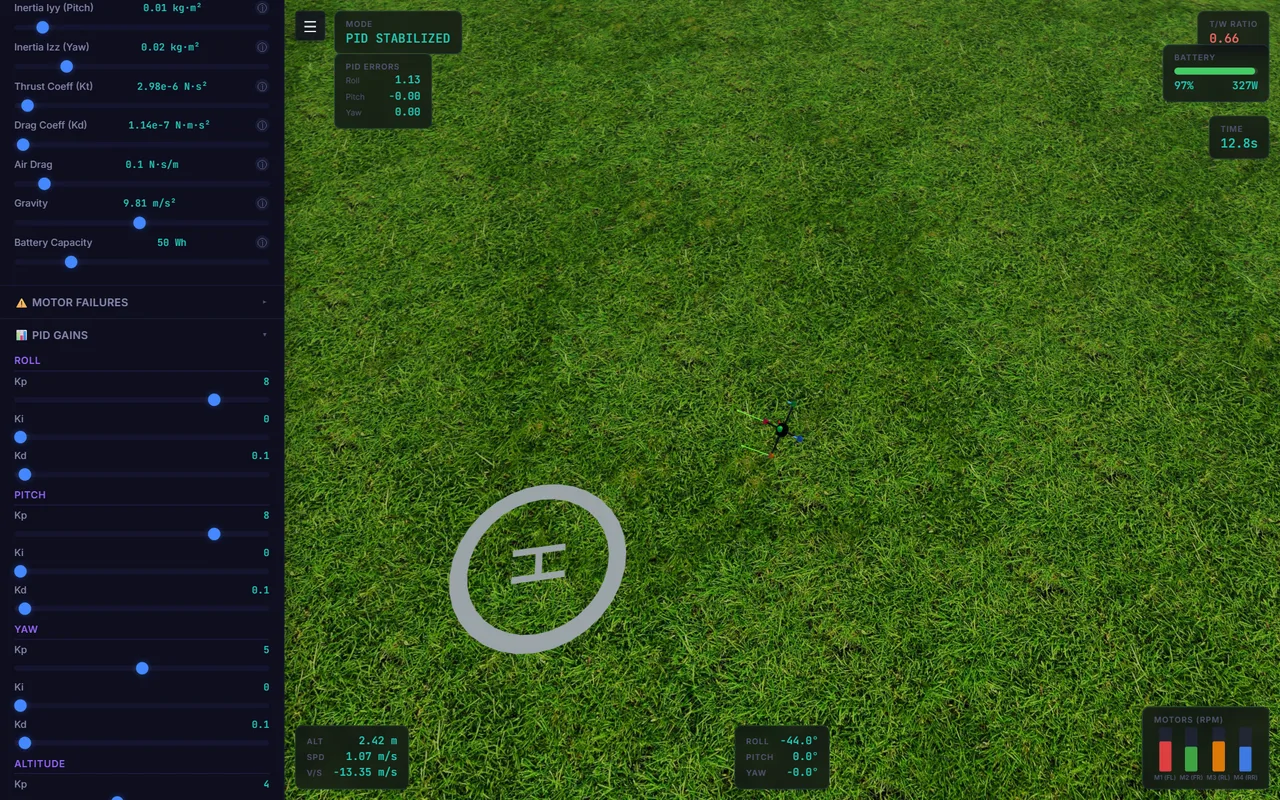
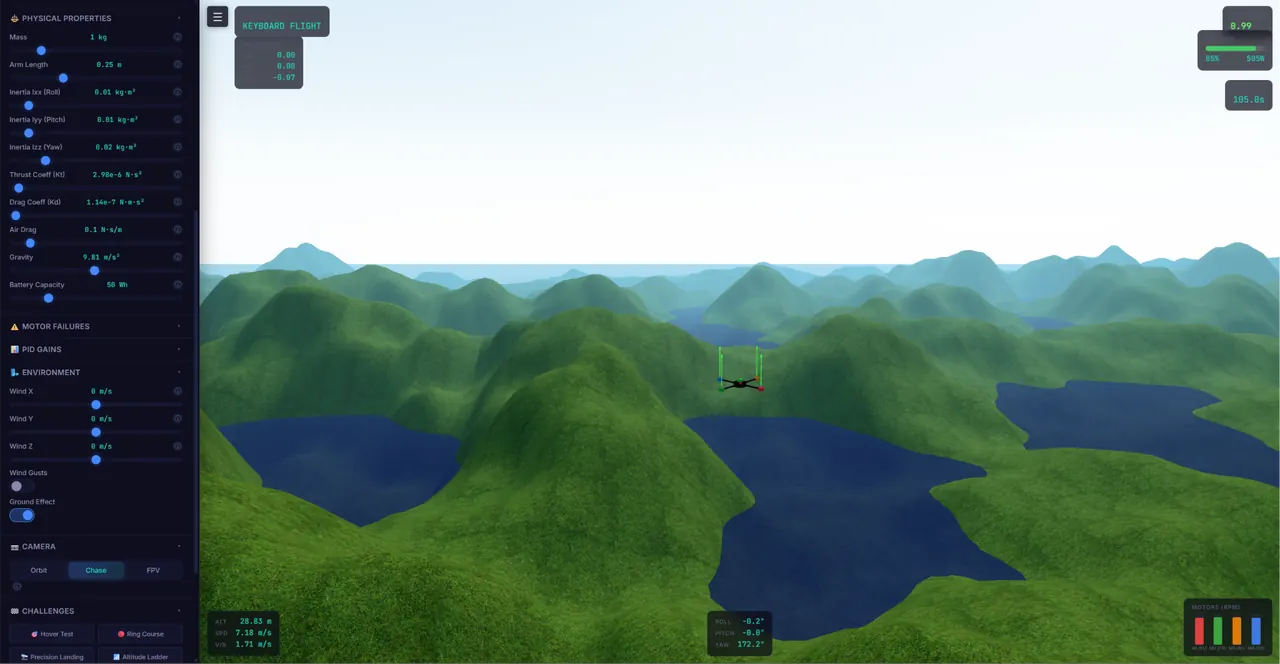
- Tinkerable physics. Mass, inertia, drag, thrust coefficients, and environmental wind and gravity are all exposed as parameters.
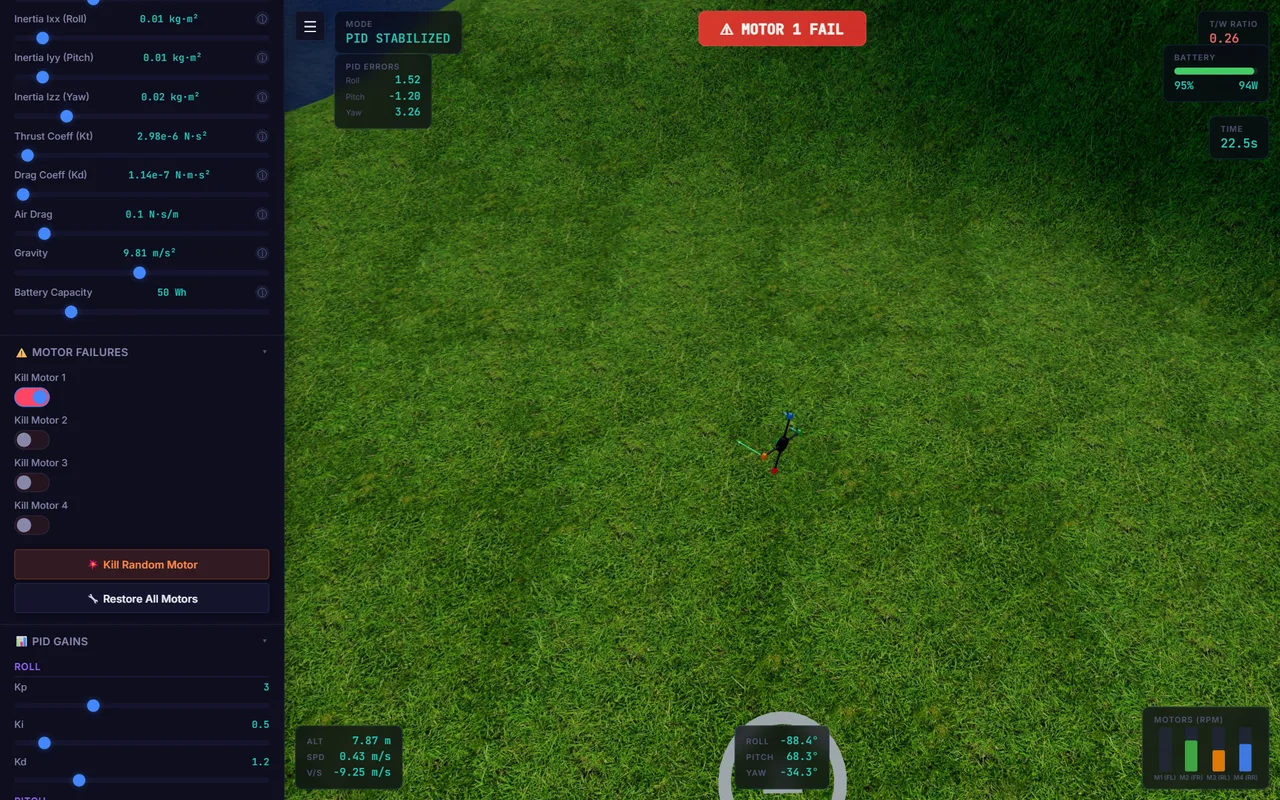
- Failure scenarios. Trigger motor failures to see how the drone reacts, and practise the recovery.
- Control modes. Fly a quadcopter or a hexacopter in Direct mode (raw motor percentages), PID Stabilized, from the keyboard, or from the phone remote, with every PID gain live on a slider.
- Flight challenges. Hover Test, Ring Course, Precision Landing and Altitude Ladder, watched from an orbit, chase or FPV camera.
- Phone as remote. Running locally, the simulator accepts a phone connection through its browser, with dual virtual joysticks sending input over WebSockets.
Key features
-
01
Motor failures
Fail a motor mid-flight and train the recovery.
-
02
Tunable physics
Mass, inertia, drag and thrust coefficients.
-
03
Environment
Wind with gusts, gravity down to the Moon’s, and ground effect.
-
04
Direct & PID
Direct, PID, keyboard or phone, with live gains.
-
05
Phone remote
Dual virtual joysticks in the mobile browser.
-
06
Runs online
Try it at drone.sriram4n.com.
Challenges & what I learned
Every exposed parameter is another way for the model to go unstable, so good defaults matter as much as flexibility. Tuning PID gains by hand is also one of the best ways to really understand them.
What’s next
More failure scenarios, such as sensor faults and battery sag, and recorded runs for comparing pilots.
07 — Gallery
In pictures.