Project 03 AR · Mobile · SIH 2026
SurakshaAR
An ordinary Android phone measures the room a worker is standing in, then runs a DGMS safety drill inside it. No headset, no ARCore, no internet at any point.
Overview
SurakshaAR is an AR safety-training and certification app for Jharkhand’s mining, steel and manufacturing workers, built for Smart India Hackathon 2026 under the Smart Education theme.
A worker sweeps the room with an ordinary Android phone, practices a timed safety drill inside that measured space, and comes away with a signed certificate an inspector can check at the pit head with no account and no signal.
The problem
Jharkhand had 12 coal-mine deaths in 2023, more than any other state, according to the DGMS returns tabled in Parliament. A week after a safety lecture, only 10–30% of it is left; practice with visible consequences is what closes that gap.
Simulator rooms and VR headsets exist, but they reach plant employees, not contract crews on six-month tickets, and they need hardware, licences and a data connection that small mines don’t have.
How it works
- Tracking from the gyroscope. Rotation comes from Android’s game rotation vector (gyroscope and accelerometer), with a Madgwick filter as a fallback. It deliberately skips the magnetometer, which steel plants and underground galleries wreck, and needs no ARCore-certified hardware: Android 10, a gyroscope and a camera are enough.
- Measuring the room. Gravity gives the floor plane, and the worker’s height and how they hold the phone give the camera height that scales every measurement. A 32 × 64 grid of brightness and texture traces the floor and pairs vertical edges into doorways, kept only if they measure 0.6–1.6 m wide and 1.5–2.6 m tall. No ML model ships.
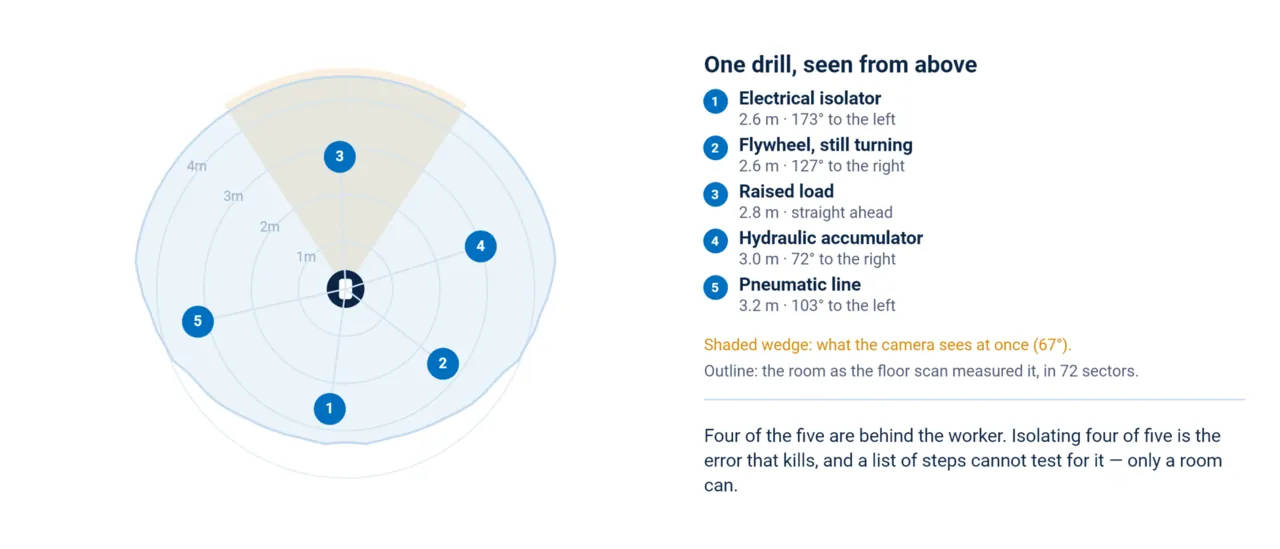
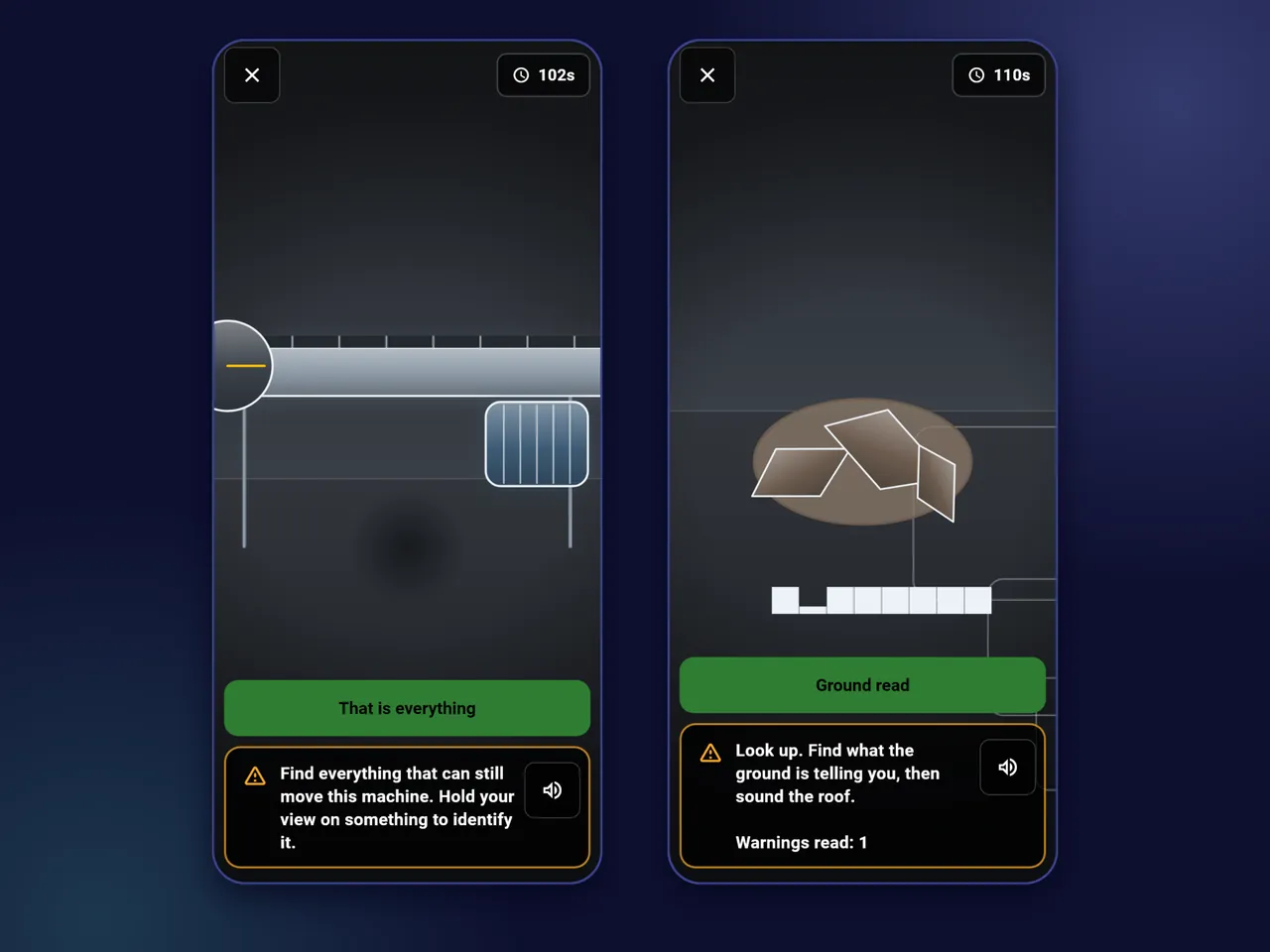
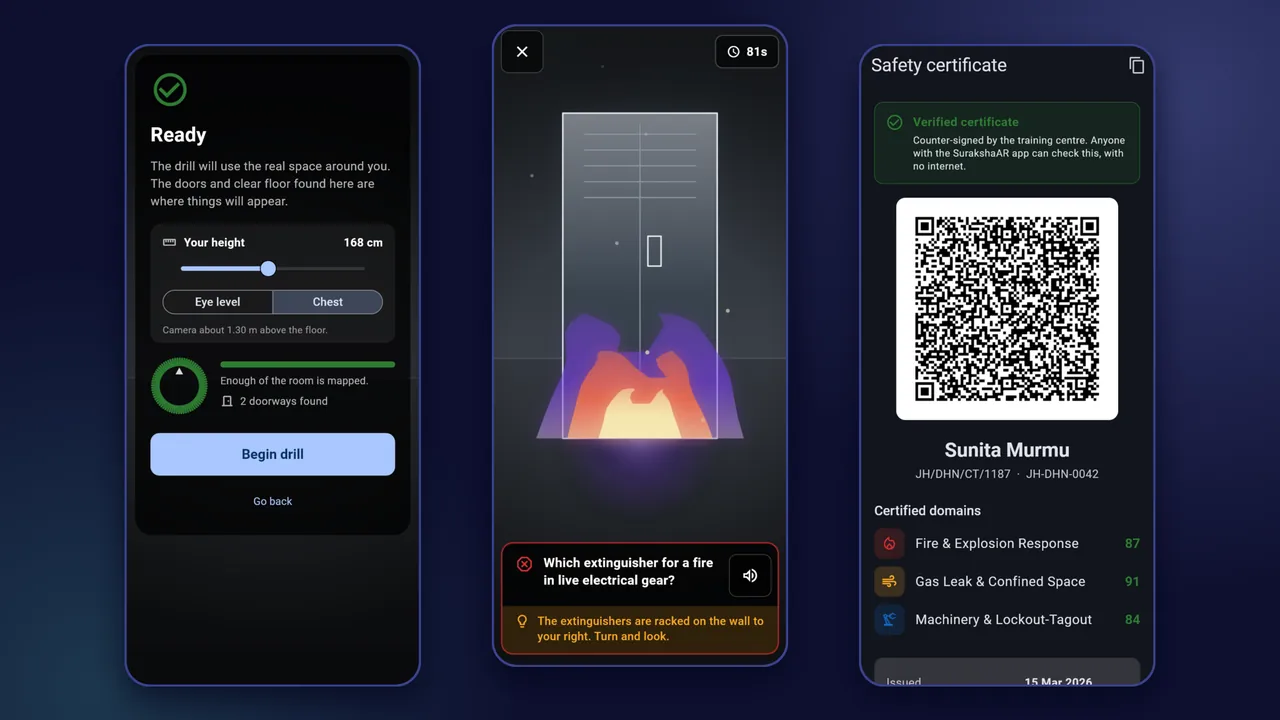
- Drills inside the measured room. Hazards are placed in the real space: the right extinguisher is racked behind the worker, who has to turn and find it.
- Spoken aloud. Every step is read by the phone’s own speech engine, in English or Hindi. No audio ships in the APK.
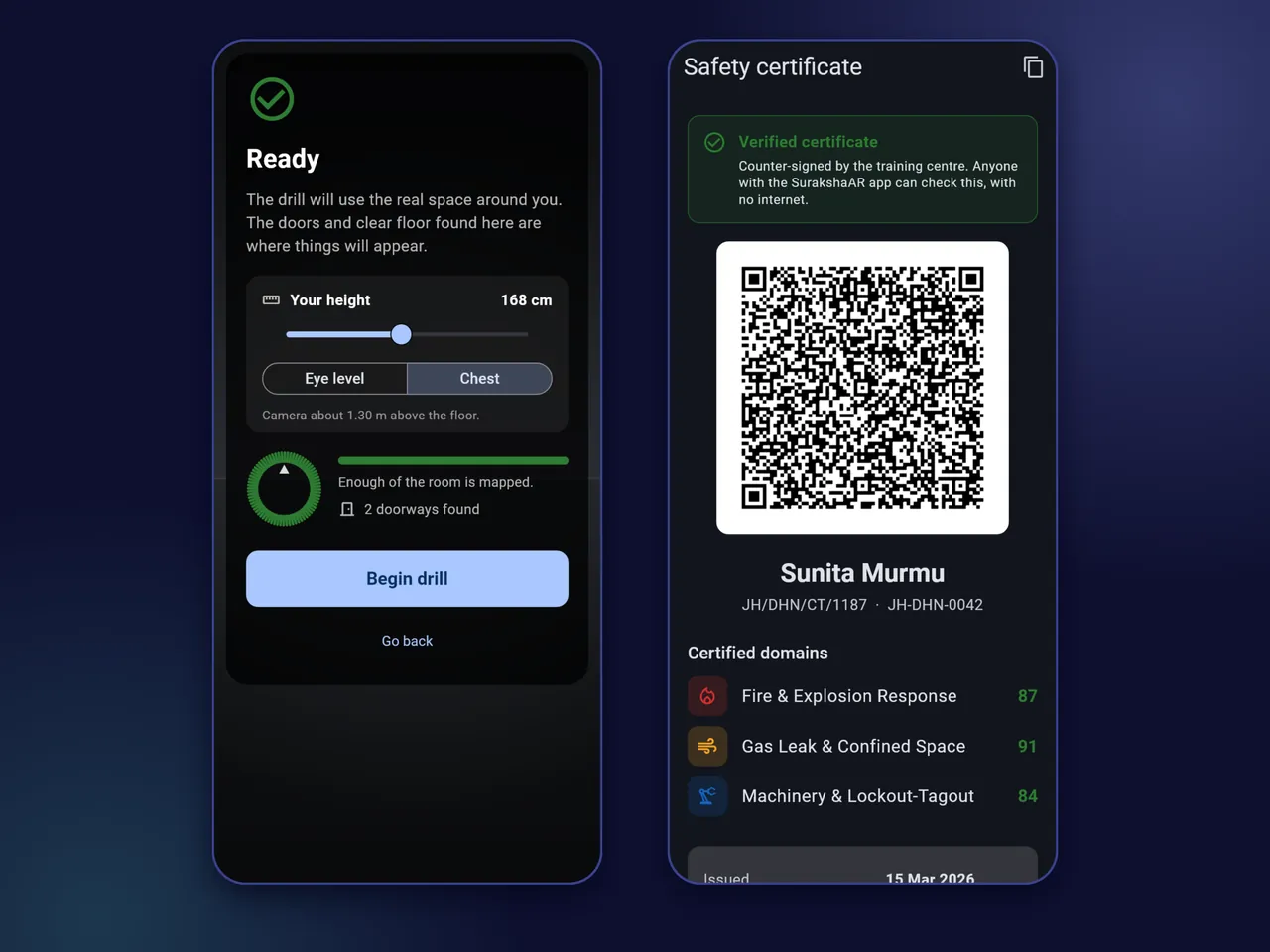
- Certificates that verify offline. A drill result is encoded as canonical CBOR, signed with Ed25519, base45-encoded and drawn as a QR code: the same shape of credential India already issues through DIVOC and CoWIN.
- Offline by design. Records live in SQLite on the phone. The only networking is optional sync of signed record bundles to a supervisor’s laptop over a shared hotspot.
Key features
-
01
No headset, no ARCore
An Android 10 phone with a gyroscope and a camera.
-
02
Measures the real room
Floor, clear distance in 72 directions, and real doorways.
-
03
15 timed drills
Five DGMS-aligned domains, three acts in each.
-
04
Spoken aloud
Each step read by the phone’s own voice.
-
05
Offline certificates
Ed25519-signed QR codes, verified with no signal.
-
06
Nothing leaves the phone
There is no endpoint to switch off.
Challenges & what I learned
Camera height is the one unknown left in the geometry, so it multiplies every real-world measurement the engine makes: door widths, fire placement, wall distance. An early height slider returned a constant while claiming to measure; camera height now comes from the worker’s stature and how they hold the phone.
A less obvious one, found by measurement and now pinned by a test: rows, not columns, carry the accuracy. A door’s height comes from the topmost row its edge reaches, so the grid is deliberately tall. Doubling the columns changes nothing and doubles the cost.
What’s next
A supervisor dashboard on a laptop that takes in signed record bundles and counter-signs them; more drill domains such as haulage and blasting; a Santali voice, since no speech engine reads Ol Chiki yet; and a regulator key, so DGMS can sign where an employer does today.
07 — Gallery
In pictures.